Looking Forward to Sunday at St. Thomas—Trinity 9
Start Here: Looking Forward with Issues, Etc.
Each week, the Lutheran radio program Issues, Etc. features an hour long conversation that walks through the propers for the upcoming Sunday in the Church Year. This is a helpful way to prepare your heart and mind to hear God’s Word and receive His gifts.
Listen Now—”Looking Forward to Sunday Morning: Ninth Sunday after Trinity”
The Bach Cantata for This Sunday
Johann Sebastian Bach composed sacred cantatas for nearly every Sunday and feast day in the Church Year. These cantatas proclaim Christ through the same Scripture readings and themes appointed for each Sunday.
This Week’s Cantata:
BWV 105—”Lord, Do Not Enter into Judgment with Your Servant”
Watch the Performance:
Read the English Translation:
From BachCantataTexts.org—Texts and Historically-Informed Translations for the Music of Johann Sebastian Bach
Sacred Art: The Gospel in Image
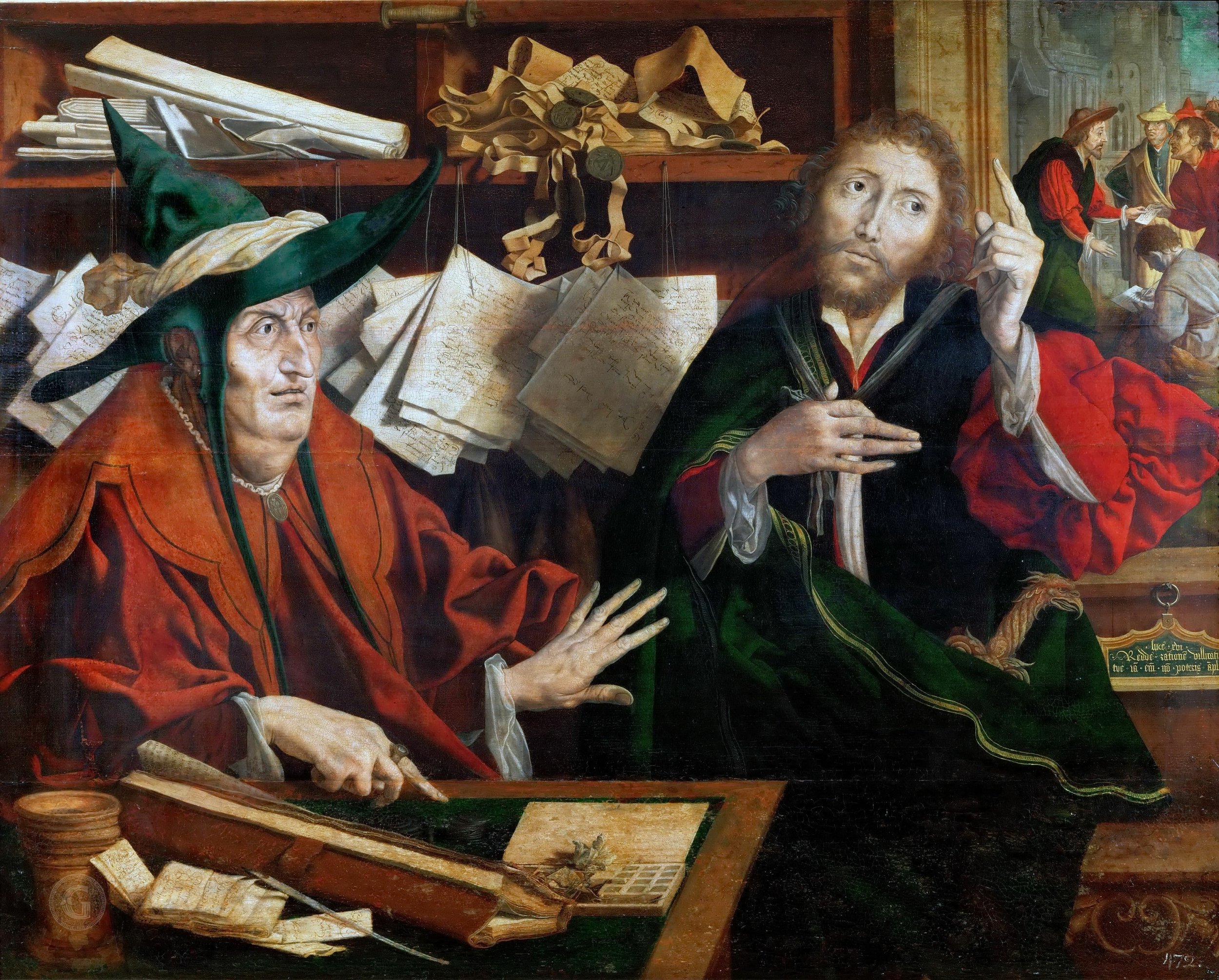
Parable of the Unjust Steward
van Reymerswaele, Marinus, c. 1540
Brief Commentary
Marinus van Reymerswaele’s Parable of the Unjust Steward (c. 1540) visually unfolds Christ’s parable from Luke 16 with layered moral tension. In the foreground, the rich man sits amid coins and contracts, facing his steward—who stands deep in thought—symbolizing the tension between authority and cunning. In the upper right, a smaller scene depicts what the steward is plotting: reducing the debts owed to his master in order to secure future favor. Van Reymerswaele contrasts material shrewdness with moral reckoning, inviting the viewer to consider Christ’s unsettling commendation of such cunning and to reflect on how temporal resources might be used wisely in light of eternal accountability.
The Propers for the Ninth Sunday after Trinity
-
Psalm 54:4–5, 1
Behold, God is mine helper: the Lord is with them that uphold my soul. He shall reward evil unto mine enemies: cut them off in Thy truth, O Lord my shield.Great is the LORD, and greatly to be praised in the city of our God, in the mountain of His holiness.
Save me, O God, by Thy name, and judge me by Thy strength.
-
Let Your merciful ears, O Lord, be open to the prayers of Your humble servants; and that they may obtain their petitions, make them to ask such things as shall please You; through Jesus Christ, Your Son, our Lord, who lives and reigns with You and the Holy Spirit, one God, now and forever.
-
Proverbs 16:1–9
The preparations of the heart belong to man, but the answer of the tongue is from the LORD. All the ways of a man are pure in his own eyes, but the LORD weighs the spirits. Commit your works to the LORD, and your thoughts will be established. The LORD has made all for Himself, yes, even the wicked for the day of doom. Everyone proud in heart is an abomination to the LORD; though they join forces, none will go unpunished. In mercy and truth atonement is provided for iniquity; and by the fear of the LORD one departs from evil. When a man’s ways please the LORD, He makes even his enemies to be at peace with him. Better is a little with righteousness, than vast revenues without justice. A man’s heart plans his way, but the LORD directs his steps.
-
Psalm 8:1a, 1b
O LORD our Lord, how excellent is Thy name in all the earth!
Who hast set Thy glory above the heavens.
-
1 Corinthians 10:6b–13
Brethren: We should not lust after evil things as our fathers lusted. And do not become idolaters as were some of them. As it is written, “The people sat down to eat and drink, and rose up to play.” Nor let us commit sexual immorality, as some of them did, and in one day twenty-three thousand fell; nor let us tempt Christ, as some of them also tempted, and were destroyed by serpents; nor complain, as some of them also complained, and were destroyed by the destroyer. Now all these things happened to them as examples, and they were written for our admonition, upon whom the ends of the ages have come. Therefore let him who thinks he stands take heed lest he fall. No temptation has overtaken you except such as is common to man; but God is faithful, who will not allow you to be tempted beyond what you are able, but with the temptation will also make the way of escape, that you may be able to bear it.
-
Psalm 78:1a
Give ear, O My people, to My law.
-
Luke 16:1–9
At that time Jesus spoke this parable to His disciples: “There was a certain rich man who had a steward, and an accusation was brought to him that this man was wasting his goods. So he called him and said to him, ‘What is this I hear about you? Give an account of your stewardship, for you can no longer be steward.’ Then the steward said within himself, ‘What shall I do? For my master is taking the stewardship away from me. I cannot dig; I am ashamed to beg. I have resolved what to do, that when I am put out of the stewardship, they may receive me into their houses.’ So he called every one of his master’s debtors to him, and said to the first, ‘How much do you owe my master?’ And he said, ‘A hundred measures of oil.’ So he said to him, ‘Take your bill, and sit down quickly and write fifty.’ Then he said to another, ‘And how much do you owe?’ So he said, ‘A hundred measures of wheat.’ And he said to him, ‘Take your bill, and write eighty.’ So the master commended the unjust steward because he had dealt shrewdly. For the sons of this world are more shrewd in their generation than the sons of light. And I say to you, make friends for yourselves by unrighteous mammon, that when you fail, they may receive you into an everlasting home.”
-
One thing’s needful; Lord, this treasure
Teach me highly to regard.
All else, though it first give pleasure,
Is a yoke that presses hard!
Beneath it the heart is still fretting and striving,
No true, lasting happiness ever deriving.
This one thing is needful; all others are vain—
I count all but loss that I Christ may obtain!How were Mary’s thoughts devoted
Her eternal joy to find
As intent each word she noted,
At her Savior’s feet reclined!
How kindled her heart, how devout was its feeling,
While hearing the lessons that Christ was revealing!
All earthly concerns she forgot for her Lord
And found her contentment in hearing His Word.Wisdom’s highest, noblest treasure,
Jesus, is revealed in You.
Let me find in You my pleasure,
And my wayward will subdue,
Humility there and simplicity reigning,
In paths of true wisdom my steps ever training.
If I learn from Jesus this knowledge divine,
The blessing of heavenly wisdom is mine.Nothing have I, Christ, to offer,
You alone, my highest good.
Nothing have I, Lord, to proffer
But Your crimson-colored blood.
Your death on the cross has death wholly defeated
And thereby my righteousness fully completed;
Salvation’s white raiments I there did obtain,
And in them in glory with You I shall reign.Therefore You alone, my Savior,
Shall be all in all to me;
Search my heart and my behavior,
Root out all hypocrisy.
Through all my life’s pilgrimage, guard and uphold me,
In loving forgiveness, O Jesus, enfold me.
This one thing is needful; all others are vain—
I count all but loss that I Christ may obtain!
-
Psalm 19:8a, 10b–11a
The statutes of the LORD are right, rejoicing the heart: sweeter also than honey and the honeycomb. Moreover by them is Thy servant warned.
-
Matthew 6:33
Seek ye first the kingdom of God; and all these things shall be added unto you, saith the Lord.
Lectionary Theme Summary
This Sunday’s readings center on:
The Steward’s Shrewdness Sanctified
“The master commended the dishonest manager for his shrewdness” (Luke 16:1–9). The steward’s shrewdness is praiseworthy for two reasons. First, he knew the master would be merciful. He trusted that the master would honor the debts he forgave in the master’s name. In the same way, though we have squandered our heavenly Father’s possessions in selfishness and sin, Jesus is the Steward who has canceled our debt, knowing that His forgiveness will be honored by the Father because of the holy cross. Secondly, the steward was shrewd in using oil and wheat to provide for his earthly welfare. So also do these earthly elements aid us when pressed into heavenly use in the anointing of baptism and the wheat of the Lord’s Supper. Those who have the Sacraments will have an eternal home when their earthly home fails. These provide us aid in times of temptation (1 Cor. 10:6–13). For the Lord is our strength and a shield to all who trust in Him (2 Sam. 22:26–34).
Veit Dietrich’s Summary Prayer:
Lord God, heavenly Father, You generously give us Your blessing and our daily bread. Preserve us from greed and awaken our hearts that we willingly share Your blessed gifts with our neighbors in need. Make us faithful stewards of Your gifts and be gracious to us when our time of stewardship is done and we come before Your judgment; through our Lord Jesus Christ, Your Son, who lives and reigns with You and the Holy Spirit, one true God, now and forever. Amen.
Voices of the Church: Fathers and Confessions
Each Sunday, the Church gathers to hear Christ in the Scriptures, and she has always confessed that Word with one voice. This section features brief excerpts from the Church Fathers, the Lutheran Confessions, and especially the Large Catechism and the Formula of Concord. These selections highlight how the Church in every age has confessed the same faith drawn from God’s Word. Use them for meditation and instruction as we prepare to receive Christ’s gifts anew.
From the Church Fathers
BASIL THE GREAT OF CAESAREA (HOMILY ON “I WILL PULL DOWN MY BARNS”)
Remember your Benefactor, O man! Be mindful of yourself, who you are, of what things have been placed in your charge, from Whom you receive them, and why you were favored above others. You have been made a servant of the good God; an administrator for your fellow servant. Do not imagine that all these fruits were prepared for your stomach. Regard what you hold within your own hands as though it belonged to others. For a little while these things will give you pleasure; then slipping away from you they disappear, and then you must render a strict account of them. But you try with bolts and bars to keep them all hidden and sealed up, and you watch them anxiously. And you think within yourself, “What shall I do? What shall I do?”
Offhand I would say: “I will fill the souls of the hungry. I will open my barns, and I will send for all who are in need. I will be like Joseph in proclaiming the love of my fellow man. I will cry out with a mighty voice: ‘Come to me all of you who lack bread; let each of you take, according to his need, from the abundance that divine love has given to me…’”
Imitate the earth, O man, and bear fruit as it does, so that you may not be lower than the senseless creation. It nourishes its fruits to serve you, not for its own delight. Whenever you yield fruits of charity, you gather up for yourself; for the grace and reward of good works is returned to the giver. Have you given something to a person in need; what you have given becomes yours and is returned to you with interest. And as the wheat that falls to the earth brings increase to the one who has thrown it there, so the bread that you give to the hungry will later bring you a great gain. So let the end of your earthly tilling be the beginning of your heavenly sowing.
From the Large Catechism
THE FOURTH COMMANDMENT (I.129-130)
God knows very well this perverseness of the world; therefore, He admonishes and urges by commandments that everyone consider what his parents have done for him. Each child will discover that he has from them a body and life. He has been fed and reared when otherwise he would have perished a hundred times in his own filth. Therefore, this is a true and good saying of old and wise people: “To God, to parents, and to teachers we can never offer enough thanks and compensation.” The person who thinks about and considers this will give all honor to his parents without force and bear them up on his hands as those through whom God has done him all good [Psalm 91:12].
THE FIRST ARTICLE OF THE CREED (II.23-24)
We ought, therefore, daily to recite this article. We ought to impress it upon our mind and remember it by all that meets our eyes and by all good that falls to us. Wherever we escape from disaster or danger, we ought to remember that it is God who gives and does all these things. In these escapes we sense and see His fatherly heart and His surpassing love toward us [Exodus 34:6]. In this way the heart would be warmed and kindled to be thankful, and to use all such good things to honor and praise God.
We have most briefly presented the meaning of this article. This is how much is necessary at first for the most simple to learn about what we have, what we receive from God, and what we owe in return. This is a most excellent knowledge but a far greater treasure. For here we see how the Father has given Himself to us, together with all creatures, and has most richly provided for us in this life. We see that He has overwhelmed us with unspeakable, eternal treasures by His Son and the Holy Spirit, as we shall hear [Colossians 2:2].
From the Formula of Concord
GOOD WORKS (IV.9-12)
Faith must be the mother and source of works that are truly good and well pleasing to God, which God will reward in this world and in the world to come. This is why St. Paul calls them true fruit of faith, also fruit of the Spirit [Galatians 5:22–23]. For, as Dr. Luther writes in the Preface to St. Paul’s Epistle to the Romans:
“Faith, however, is a divine work in us that changes us and makes us to be born anew of God, John 1[:12–13]. It kills the old Adam and makes us altogether different men, in heart and spirit and mind and powers; it brings with it the Holy Spirit. O, it is a living, busy, active, mighty thing, this faith. It is impossible for it not to be doing good works incessantly. It does not ask whether good works are to be done, but before the question is asked, it has already done them, and is constantly doing them. Whoever does not do such works, however, is an unbeliever. He gropes and looks around for faith and good works, but knows neither what faith is nor what good works are. Yet he talks and talks, with many words, about faith and good works.
Faith is a living, daring confidence in God’s grace, so sure and certain that the believer would stake his life on it a thousand times. This knowledge of and confidence in God’s grace makes men glad and bold and happy in dealing with God and all creatures. And this is the work that the Holy Spirit performs in faith. Because of it, without compulsion, a person is ready and glad to do good to everyone, to serve everyone, to suffer everything, out of love and praise to God, who has shown him this grace. Thus it is impossible to separate works from faith, quite as impossible as to separate heat and light from fire.” [LW 35:370–71]
Devotional Suggestions for the Week
Pray the Collect.
Read aloud at least the Gospel text one evening as a family and discuss the sacred art.
Sing a stanza of the Hymn of the Day before dinner or bedtime.
Listen to the Cantata on Saturday night or Sunday morning before church.
Review the Voices of the Church section connected to this Sunday.
Stay Connected
Join us for the Chief Divine Service on Sunday at 9:00 AM and Family Catechesis at 10:30 AM at Klein Funeral Home in Magnolia (14711 FM 1488). All are welcome to hear Christ’s Word and receive His gifts.
To learn more about St. Thomas Evangelical Lutheran Church and our mission in Magnolia, visit our homepage.
